
 2 months ago
Jemma CrewBusiness reporter

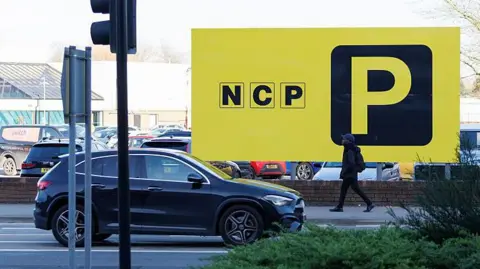 NurPhoto via Getty Images
One of the UK's biggest car park companies collapsed into administration this week, leaving almost 700 jobs at risk.
For many, their first reaction to the news was bafflement. How could a company that charged as much as £65 for a day's parking fail to turn a profit?
So where did it all go wrong for National Car Parks, and what could its future look like?
More home working, less shopping
NCP has a varied estate, with 340 car parks across the country, including in airports, train stations, hospitals and town centres.
With working from home affecting commuter demand, and shopping increasingly involving mouse clicks rather than footsteps, its city-centre and commuter car parks have had reduced occupancy.
The firm's collapse shows the "combined impact of flexible working, cost-of-living challenges and fuel prices, as well as the general fall in high street shopping and increase in delivery services", says Nick Stockley, partner at Mayo Wynne Baxter.
There has "undoubtedly been a big shift" away from commuters needing parking space five days a week, says the British Parking Association (BPA). Chief engagement and policy officer Alison Tooze says habits are now far more sporadic and more people are trying to avoid paying for tickets.
"The difficulty has been knowing what normal looks like, where are we going to land post-pandemic, is this it in terms of people's travel, habits and demand for parking, and it's been a very uncertain picture."
Rising costs and parking apps
NCP's parent company, Park24, which is Japanese, said higher energy prices as a result of the outbreak of war in Ukraine in 2022 increased its operating costs.
It said this had been compounded by "persistently high" UK inflation, with NCP experiencing inflation-linked rent rises.
The costs of maintaining car park infrastructure are "huge", says the BPA's Tooze, including equipment, lighting and staffing.
They're often in prime locations so face high business rates, she says, and they require maintenance to ensure they are structurally sound as cars, including electric vehicles, get bigger and heavier.
But motoring group the AA says a failure to expand parking spaces as vehicles grew over the decades had led to issues such as scratched doors.
It added rising costs were also felt by customers, as "councils and private operators copied each other's ever-rising ticket prices", says AA president Edmund King.
People get some extra income by renting out their empty driveways, or unused spaces in residential car parks, while drivers get more choice, flexibility and value.
Punters have "voted with their wheels", says the AA's King. "NCP didn't keep up with the changing world of more flexible and app-based local parking."
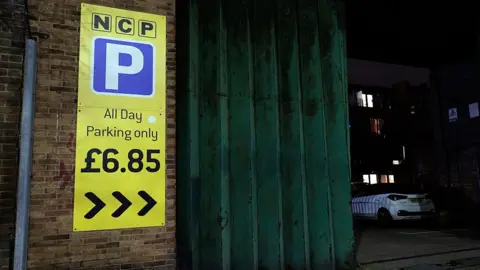 NurPhoto via Getty Images
NCP's charges vary across its sites. It costs £6.85 to park all day at this car park in Sheffield, but some central London locations charge £65 a day
NCP also had big debts. As of 30 September last year, the company's debts were £305m greater than the value of its assets, according to a filing from its parent company.
Russ Mould from the investment platform AJ Bell says business models that are better suited to carrying debt "tend to be asset-backed and come with fairly stable, predictable demand and cash flows".
"In principle, a car park would fit the bill nicely," he says.
However, he notes that interest on the debt must be paid on time, regardless of how the business is doing.
With a drop in customers since Covid-19, NCP would also have had the same, if not higher, costs in terms of utilities, maintenance and staff "regardless of how many cars do or do not park".
It may be that one of NCP's biggest strengths - the hundreds of car parks it runs across the UK - actually ended up speeding up its demise.
Administrators PwC said this week it had a "high concentration" of inflexible, long-term leases that prevented it from reducing costs or scrapping unprofitable sites. "Significant" rent payments were due at the end of the month, Park24 said.
In these situations, providers are stuck with an asset that is difficult to make profitable unless they increase the cost of parking, says Tooze of the BPA.
"Then there is a sort of price elasticity tolerance that if you put it up too much, no-one's going to pay it," she says.
"And there's nothing you can really do to change that until the lease is up, you can't sort of sublet. Car parks are not easy structures to do anything different with."
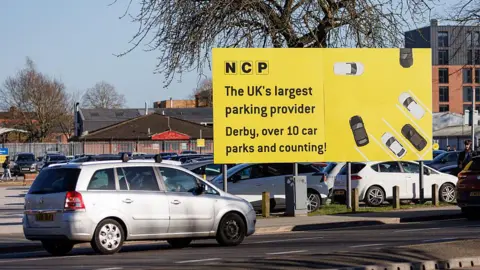 NurPhoto via Getty Images
The number of car parks NCP runs could have contributed to its downfall
Michael Lynch, partner at city law firm DMH Stallard and specialist in business restructuring and insolvency, says administrators will be looking at what costs can be dealt with.
This could include making staff redundant, or negotiating with landlords to lessen the burden of "onerous contracts". With lease discussions, it can be a question of "who's gonna budge first?” he says.
Options administrators will look at include selling the company, selling some assets, or in the last resort, winding it up.
Nick Stockley, of Mayo Wynne Baxter, says the more profitable locations, such as airports and stations, will likely remain as car parks.
But struggling sites will be sold, and he believes some, particularly those in town centres, will be of interest to residential property developers.
PwC says it is working to ensure the car parks stay open while it assesses the business, but some may close.
So, for now at least, drivers are likely to experience business as usual.


